Products
Used IBC Totes
Quality-inspected used intermediate bulk containers at up to 60% less than new. Every tote is leak-tested and graded so you know exactly what you're getting.
Get a Quote on Used IBC Totes
Tell us your quantity, grade preference, and intended use. We'll respond within 24 hours.
About
What Are Used IBC Totes?
An Intermediate Bulk Container (IBC) tote is a reusable industrial container designed for storing and transporting bulk liquids and granulated materials. Standard IBCs consist of an HDPE (high-density polyethylene) bottle housed inside a galvanized steel cage, mounted on a pallet base.
Used IBC totes have completed their first lifecycle carrying products like food-grade syrups, soaps, chemicals, or agricultural inputs. After inspection, cleaning, and grading, these containers are fully capable of years of additional service at a fraction of the cost of new.
By purchasing used IBCs, you're keeping approximately 130 pounds of HDPE plastic per container out of the waste stream and eliminating the CO2 emissions associated with new manufacturing.
Conditions
Detailed Condition Grading
Grade A — Like-New
30-40% off newMinimal cosmetic wear. Clean interior, intact labels, no staining or odor. Ideal for food-grade and pharmaceutical applications. HDPE bottle retains original translucency with wall thickness within 95% of factory specification. Cage zinc coating fully intact with no visible rust. Valve operates smoothly with zero drip at full closure.
Grade B — Good Condition
40-55% off newLight scuffing on cage or bottle. May have minor label residue or slight discoloration. Fully functional for agricultural, chemical, and industrial uses. Bottle is structurally sound with no cracks or punctures. Cage may show minor surface oxidation that does not affect structural integrity. Valve tested and confirmed leak-free.
Grade C — Fair Condition
55-70% off newVisible wear, possible discoloration from UV exposure or previous contents. Structurally sound and leak-tested. Best for non-sensitive storage, rainwater collection, and irrigation. May have moderate label ghosting and cage wear. Wall thickness meets minimum safety thresholds. Represents the best value per gallon of storage capacity available.
Applications
Industries We Serve
Used IBC totes serve thousands of applications across virtually every industry. Their 275 or 330 gallon capacity, forklift-compatible design, and stackable profile make them the most versatile bulk container available.
Agriculture & Farming
Used IBC totes are the backbone of modern farm operations. Store fertilizer concentrates, pesticide solutions, liquid feed supplements, and irrigation water in 275 or 330 gallon containers that fit on any standard tractor forklifts. Grade B and C totes deliver excellent value for non-food agricultural applications.
Food & Beverage Processing
Grade A used totes with documented food-grade history are approved for transporting and storing edible oils, fruit juice concentrates, syrups, wine, sauces, and other food ingredients. FDA 21 CFR 177 compliant containers maintain the safety standards required for human-consumption products.
Chemical Manufacturing
Store and transport industrial chemicals, solvents, degreasers, and cleaning compounds. IBC totes with UN/DOT ratings (UN 31HA1/Y) are suitable for regulated hazardous material applications. The HDPE bottle resists a wide range of acids, bases, and organic solvents.
Construction & Concrete
Construction sites use IBC totes for water supply, dust suppression, concrete curing, equipment washing, and temporary potable water storage. Grade C totes offer the lowest cost per unit for single-project deployments where cosmetic appearance is irrelevant.
Soap & Detergent Manufacturing
The 330-gallon IBC with a 3-inch butterfly valve is the industry standard for soap, detergent, and cleaning product manufacturers. The wide-mouth valve allows viscous liquids to flow freely, and the HDPE bottle is chemically compatible with surfactants, fragrances, and alkaline solutions.
Cannabis & Hemp Processing
Cannabis cultivation and hemp extraction facilities use IBC totes for nutrient solution mixing, water storage, and waste liquid collection. Grade B totes are popular for nutrient reservoirs, while Grade A food-grade containers are specified for extraction-grade solvent storage.
Wine, Spirits & Craft Brewing
Wineries and craft breweries use food-grade IBC totes for bulk wine and beer transfers, cleaning solution storage, and water treatment chemical holding. The 275-gallon size fits through standard winery doors and can be forklift-maneuvered in tight cellar spaces.
Aquaponics & Hydroponics
IBC totes are the foundation of countless aquaponics and hydroponics systems. The top half serves as a grow bed while the bottom acts as a fish tank or nutrient reservoir. Grade C totes are the most cost-effective option for these converted applications.
Emergency Preparedness
Municipal emergency management agencies and private preppers alike use IBC totes for bulk water reserves. A single 330-gallon tote provides approximately 22 days of water for a family of four at the recommended one gallon per person per day for drinking and sanitation.
Landscaping & Irrigation
Landscaping companies use IBC totes mounted on trailers for mobile water supply. Connect a garden hose adapter to the 2-inch butterfly valve and you have a gravity-fed irrigation system that delivers consistent flow to newly planted trees, sod, and garden beds.
Automotive & Fleet Maintenance
Auto shops and fleet maintenance facilities store bulk quantities of antifreeze, windshield washer fluid, brake cleaner, and used oil in IBC totes. The 275-gallon size fits in most shop bays, and the butterfly valve provides controlled dispensing for fluid top-offs.
Water Treatment & Municipal
Municipal water treatment plants use IBC totes for chemical dosing agents including chlorine solutions, pH adjusters, and flocculants. UN/DOT-rated containers are required for many treatment chemicals, and our reconditioned IBCs meet these standards.
Buying Research
Read Before You Buy
If you are comparing grades, sizes, or lifecycle cost, these guides answer the questions buyers usually ask before ordering used inventory.
Technical Data
Material Specifications
Understanding the materials that make up an IBC tote helps you evaluate suitability for your specific application. Here are the detailed material properties for standard IBC containers.
Compatibility
Chemical Compatibility Guide
HDPE is one of the most chemically resistant plastics available, but it is not universally compatible. This reference covers common substances stored in IBC totes. Always verify compatibility with your specific chemical formulation and concentration before use.
Compatible with HDPE
- Water (deionized, distilled, tap)
- Acetic Acid (up to 50%)
- Hydrochloric Acid (up to 37%)
- Sulfuric Acid (up to 70%)
- Sodium Hydroxide (up to 50%)
- Phosphoric Acid (up to 85%)
- Citric Acid (all concentrations)
- Isopropyl Alcohol (up to 100%)
- Ethanol (up to 95%)
- Hydrogen Peroxide (up to 35%)
- Ammonia Solutions (up to 30%)
- Sodium Hypochlorite (bleach, up to 12.5%)
- Glycerin / Glycerol
- Mineral Oils
- Detergents & Surfactants
- Fertilizer Solutions (N-P-K)
NOT Compatible with HDPE
- Acetone
- Toluene / Xylene
- Concentrated Nitric Acid (>70%)
- Chlorinated Solvents (DCM, TCE)
- Concentrated Sulfuric Acid (>70%)
These substances can cause swelling, softening, stress cracking, or permeation of the HDPE bottle. Use stainless steel IBCs for these applications.
Storage
Stacking & Storage Guidelines
Proper stacking maximizes warehouse floor space while maintaining safety. Follow these guidelines based on your IBC size, pallet type, and fill status.
| Configuration | Max Stack | Notes |
|---|---|---|
| 275 gal on steel/HDPE pallet — filled | 4 high | Maximum total height approximately 15.3 feet. Ensure level, load-rated flooring. |
| 275 gal on wood pallet — filled | 3 high | Wood pallets have lower compression ratings. Inspect for cracking before stacking. |
| 330 gal on steel/HDPE pallet — filled | 3 high | Maximum total height approximately 13.3 feet. Greater weight per level requires wider floor load distribution. |
| 330 gal on wood pallet — filled | 2 high | Heavy load on wood pallets limits safe stacking. Consider upgrading to steel pallets for higher stacks. |
| Any size — empty | 4 high | Secure against wind and lateral forces. Empty IBCs are top-heavy relative to their weight. |
Additional Storage Best Practices
- Store IBCs on level, load-rated surfaces. Concrete floors are ideal; compacted gravel is acceptable for outdoor storage.
- Keep IBCs away from direct sunlight when possible. UV exposure accelerates HDPE degradation and can reduce remaining lifespan by 40-60%.
- Maintain minimum 36-inch aisle spacing between IBC rows for forklift access and fire safety compliance.
- For chemical storage, place IBCs inside secondary containment pallets rated for 110% of the container's volume.
- Inspect stacked configurations monthly. Look for cage deformation, pallet cracking, and any signs of leakage on lower units.
Longevity
Expected Lifespan & Fill Cycles
The remaining useful life of a used IBC depends on storage conditions, the substances stored, and how frequently the container is cycled. These estimates are based on industry data for standard HDPE IBCs.
| Storage Condition | Expected Lifespan | Estimated Fill Cycles |
|---|---|---|
| Indoor, climate-controlled, single substance | 8 – 12 years | 15 – 25 fill cycles |
| Indoor, ambient temperature, varied substances | 5 – 8 years | 10 – 15 fill cycles |
| Covered outdoor, moderate climate | 4 – 6 years | 8 – 12 fill cycles |
| Exposed outdoor, direct sunlight | 2 – 4 years | 5 – 8 fill cycles |
| Harsh chemicals, frequent cycling | 2 – 3 years | 4 – 6 fill cycles |
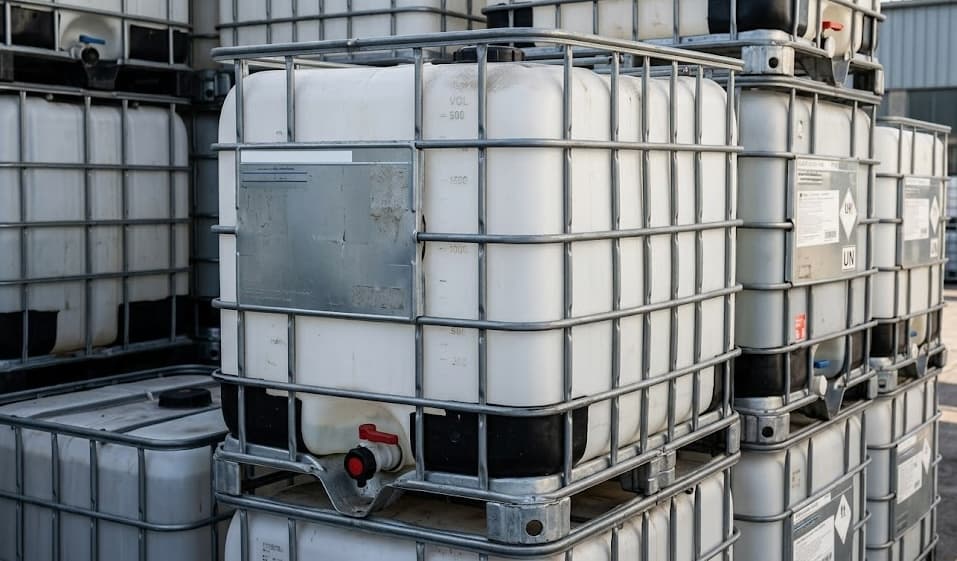
Built to Last
Steel Cage. HDPE Core. Industrial Strength.
Value
Cost-Per-Use Analysis
When you factor in the purchase price and the number of fill cycles remaining, used IBC totes deliver dramatically lower cost per use than new containers. Here's how the math works for a typical 275-gallon IBC.
Grade B Used Tote — 275 Gallon
Purchase price: ~$120 | Remaining cycles: ~10
Cost per fill cycle: $12.00
Grade A Used Tote — 275 Gallon
Purchase price: ~$160 | Remaining cycles: ~15
Cost per fill cycle: $10.67
New IBC Tank — 275 Gallon
Purchase price: ~$400 | Total cycles: ~20
Cost per fill cycle: $20.00
Lower Cost Per Use
A Grade B used IBC tote costs approximately 47% less per fill cycle than a brand-new container. Over a fleet of 50 IBCs cycled 10 times each, that's a savings of roughly $4,000 compared to purchasing new.
When you add the environmental savings — 130 lbs of plastic diverted from landfill and 215 lbs of CO2 avoided per container — the value of buying used becomes even more compelling.
Compare
Used vs New: Full Comparison
A comprehensive side-by-side across 12 metrics to help you decide whether used or new IBCs are the better fit.
| Metric | Used IBC Tote | New IBC Tank |
|---|---|---|
| Unit Cost (275 gal) | $80 – $180 | $320 – $480 |
| Unit Cost (330 gal) | $100 – $220 | $380 – $560 |
| Cost Per Gallon Capacity | $0.29 – $0.67 | $1.16 – $1.70 |
| Remaining Lifespan | 3 – 8 years | 8 – 12 years |
| CO2 Footprint | ~17 lbs (transport only) | ~215 lbs (manufacturing) |
| Plastic Waste Impact | 130 lbs diverted from landfill | 130 lbs new plastic created |
| FDA Food-Grade Available | Grade A only | All units certified |
| UN/DOT Hazmat Rating | If original cert still valid | Full certification included |
| Warranty | Leak-free at delivery | Manufacturer 2-year warranty |
| Lead Time | Same-day / next-day | 3 – 10 business days |
| Cosmetic Appearance | Varies by grade (A/B/C) | Factory-new finish |
| Customization Options | Limited (aftermarket) | Full (valve, pallet, color) |
Reuse Saves More Than Money
Every used IBC you purchase prevents 215+ pounds of CO2 from entering the atmosphere and keeps 130 pounds of plastic out of landfill. That's real impact you can measure.